TRY Academy home

Safety course · Operators, maintenance & safety staff

Environmental Health & Safety Training for Water and Wastewater Treatment Plants

Hazardous atmospheres, confined spaces, lockout, chemicals, industrial hygiene, emergencies and environmental compliance — the EHS program every water and wastewater plant runs on.

Environmental Health & Safety Training for Water and Wastewater Treatment Plants is an online, self-paced course from TRYeTECH Academy covering EHS regulations and written programs, hazardous atmospheres and gas detection, confined space entry and rescue, lockout/tagout and electrical safety, chemical safety, industrial hygiene, physical hazards, fire and emergency response, and environmental compliance. It has 10 modules and 70 lessons — about 150 hours of study — and every lesson combines narrated slides with Key details, pre-task checklists, field scenarios, hands-on practice labs, worked examples, quizzes and flashcards, backed by interactive 3D simulators.

  • 10 modules
  • 70 lessons
  • ≈150 hours
  • 20 3D simulators
  • Online, self-paced
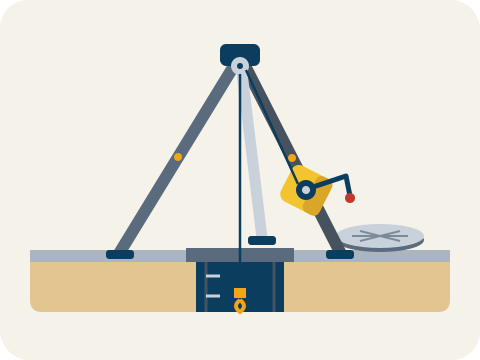
Illustration of a confined-space rescue tripod and winch set up over an open manhole

Who this course is for

Starting out

For operators, maintenance technicians, crew members and staff newly assigned safety duties. Every term is explained in plain language, each lesson opens with a pre-task checklist and the scenarios build safe work habits from day one.

Experienced & supervising

For supervisors, safety coordinators, compliance staff and plant managers. You get regulation citations, numbers you can use in the field, program-level scenarios and tracked active study hours for your training records.

What’s included

Practice labs in this course

Course sequence: EHS for Water & Wastewater Plants

2 numbered courses, 150 hours in total. Take them in order — each one prepares you for the next. Download the two-page sheet for any course, or the full course syllabus (PDF).

  1. EHS Foundations: Programs, Hazardous Atmospheres, Confined Spaces, Energy Control & Chemicals

    Foundation · 75 hours · 5 modules · 35 lessons · 10 3D simulators

    The regulations, written programs and life-critical controls every plant runs on: hazard analysis, gas detection, permit-space entry, lockout/tagout, electrical safety and chemical handling.

    • Explain how OSHA, the VOSH State Plan, EPA, Virginia DEQ and VDH divide responsibility, and which written programs a plant must keep.
    • Identify hazards, rank controls with the hierarchy of controls and prepare a job hazard analysis and tailgate talk.
    • Recognize H₂S, methane, chlorine, ammonia, CO and oxygen hazards, apply exposure limits and bump-test and calibrate gas monitors.

    Download the EHS 101 course sheet (PDF)

  2. Industrial Hygiene, Physical Hazards, Emergencies, Environmental Compliance & EHS Management

    Advanced · 75 hours · 5 modules · 35 lessons · 10 3D simulators

    Health hazards, falls, trenches, lifting and traffic, fire and emergency response, plant permits and reporting, and the management system that keeps an EHS program improving.

    • Control biological, noise, heat and ergonomic hazards and run respiratory protection and hearing conservation programs.
    • Calculate noise dose, TWA exposures and NIOSH lifting limits, and perform a certified PPE hazard assessment.
    • Apply fall-protection triggers and clearance math, protect excavations (1926 Subpart P) and plan safe lifts and rigging.

    Download the EHS 102 course sheet (PDF)

Course outline

10 modules · 70 lessons · about 15 hours per module. Lesson 1 of every module is free with an account. Download the syllabus (PDF).

  1. Module 1: EHS Foundations: Regulations, Programs & Safety Culture

    Module 1 · 7 lessons · ≈15 h

    This module builds the foundation for every other module in the course. You will see why environmental health and safety (EHS) is core work at water and wastewater utilities, and which agencies set the rules: OSHA and Virginia's VOSH State Plan for worker safety, and EPA, DEQ and VDH for permits and drinking water. You will learn what written programs a plant must keep and how a safety management system ties them…

    You will be able to:

    • Describe the main safety, health and environmental hazards found at drinking-water and wastewater utilities.
    • Explain how OSHA, the VOSH State Plan, EPA, Virginia DEQ and VDH divide responsibility for plant workers and permits.
    • Identify which OSHA standards apply to general industry work versus construction work at a utility.
    • List the written programs a typical plant must maintain and the hazard each one controls.

    Lessons

    1. EHS at water & wastewater utilities Free sample
    2. Who regulates what: OSHA, VOSH, EPA, DEQ & VDH
    3. Written safety programs & the safety management system
    4. Hazard identification & the hierarchy of controls
    5. Job hazard analysis, tailgate talks & stop-work authority
    6. Safety culture, leadership & employee involvement
    7. Injury & illness recordkeeping and reporting
  2. Module 2: Hazardous Atmospheres & Gas Detection

    Module 2 · 7 lessons · ≈15 h

    Hazardous atmospheres are the leading killer in water and wastewater confined-space work, and most of them cannot be seen or smelled reliably. This module teaches the plant gases operators meet every day: hydrogen sulfide, methane and digester gas, chlorine, ammonia, carbon monoxide and oxygen deficiency or enrichment. You will learn how exposure limits (PEL, REL, TLV, STEL, ceiling and IDLH) differ, how flammable…

    You will be able to:

    • Identify where H2S, methane, chlorine, ammonia, CO and oxygen-deficient air form or collect at water and wastewater plants.
    • Explain how vapor density, temperature, turbulence and pH affect where and how fast a plant gas is released.
    • Distinguish OSHA PELs, NIOSH RELs, ACGIH TLVs, STELs, ceilings, action levels and IDLH values and apply each correctly.
    • Calculate 8-hour TWA exposures, mixture exposure indices and ppm-to-mg/m3 conversions.

    Lessons

    1. Plant gases: H2S, methane, chlorine, ammonia, CO & oxygen deficiency Free with account
    2. Exposure limits: PEL, REL, TLV, STEL, ceiling & IDLH
    3. Flammability: LEL, UEL & classified locations
    4. Portable gas monitors: sensors, bump tests & calibration
    5. Fixed gas detection & alarm response
    6. Ventilation for atmospheric hazards
    7. Atmospheric testing procedures & records
  3. Module 3: Confined Space Entry & Rescue

    Module 3 · 7 lessons · ≈15 h

    Wet wells, manholes, digesters, valve vaults, clarifier hoppers, tanks and silos are where water and wastewater workers are most likely to die in seconds from an atmosphere they cannot see or smell. This module teaches how to recognize confined and permit-required spaces, build and run a 29 CFR 1910.146 permit program, fill out and use entry permits, and staff the entrant, attendant and entry supervisor roles. You…

    You will be able to:

    • Apply the three-part confined space definition and the four permit-space criteria to spaces at water and wastewater plants.
    • Identify atmospheric, engulfment, configuration, mechanical, electrical and other serious hazards in wet wells, digesters, vaults and tanks.
    • Describe the required elements of a written permit-required confined space program under 29 CFR 1910.146 and VOSH.
    • Complete an entry permit with acceptable entry conditions, test results, isolation measures, rescue and communication details.

    Lessons

    1. Recognizing confined & permit-required spaces at plants Free with account
    2. The permit-required confined space program (29 CFR 1910.146)
    3. Entry permits, roles & communication
    4. Isolation, purging & ventilation before entry
    5. Alternate procedures & reclassification
    6. Rescue & emergency services
    7. Confined space case studies & lessons learned
  4. Module 4: Hazardous Energy Control & Electrical Safety

    Module 4 · 7 lessons · ≈15 h

    Hazardous energy is what turns routine maintenance into amputations, crush injuries, burns and electrocutions at water and wastewater plants. This module teaches you to recognize every form of energy in plant equipment: electrical, mechanical, hydraulic, pneumatic, gravity, thermal and process pressure. It walks through the OSHA lockout/tagout standard (29 CFR 1910.147) as VOSH enforces it, then shows how to write…

    You will be able to:

    • Identify electrical, mechanical, hydraulic, pneumatic, gravity, thermal and process energy sources on common plant equipment.
    • Explain the scope, exceptions and core elements of the OSHA/VOSH lockout/tagout standard, 29 CFR 1910.147.
    • Distinguish authorized, affected and other employees and the training and retraining each requires.
    • Apply the six-step energy control sequence from preparation through verification of isolation.

    Lessons

    1. Hazardous energy at plants: electrical, mechanical, hydraulic, pneumatic & process Free with account
    2. Lockout/tagout program requirements (29 CFR 1910.147)
    3. Writing & using equipment-specific energy control procedures
    4. Group lockout, shift change & contractor coordination
    5. Electrical safety for non-electricians: NFPA 70E basics
    6. Arc flash & shock: labels, boundaries & PPE
    7. Machine guarding & rotating equipment
  5. Module 5: Chemical Safety & Process Safety Management

    Module 5 · 7 lessons · ≈15 h

    Water and wastewater plants store and feed some of the most hazardous chemicals in any community: chlorine gas, sodium hypochlorite, ammonia, sulfuric acid, caustic soda, ferric and aluminum coagulants, fluorosilicic acid and polymers. This module teaches how to read GHS labels and safety data sheets, handle disinfection chemicals and corrosives, and decide when OSHA Process Safety Management and EPA Risk Management…

    You will be able to:

    • Read a GHS label and a 16-section safety data sheet and pull out the hazard, PPE and first-aid information needed for a task.
    • Explain the employer duties of the OSHA/VOSH Hazard Communication standard (29 CFR 1910.1200), including secondary-container labels and training.
    • Describe the hazards of chlorine gas, sodium and calcium hypochlorite, ammonia and chloramines, and the controls used in feed and storage rooms.
    • Calculate chemical feed rates with the pounds formula and convert available chlorine to gallons of hypochlorite.

    Lessons

    1. Hazard communication: GHS labels & safety data sheets Free with account
    2. Disinfection chemicals: chlorine gas, hypochlorite & chloramines
    3. Corrosives, coagulants, fluoride & polymers
    4. Process safety management & risk management programs
    5. Chemical delivery, unloading & storage compatibility
    6. Emergency eyewash & shower stations
    7. Chemical spills & release response
  6. Module 6: Industrial Hygiene: Biological, Noise, Heat & Ergonomic Hazards

    Module 6 · 7 lessons · ≈15 h

    Wastewater plants expose workers to hazards that rarely trip an alarm: pathogens in sewage and biosolids, loud blowers, hot and cold weather, and heavy, awkward lifts. This module covers industrial hygiene at water and wastewater utilities. You will learn how infections spread and how hygiene, vaccinations and medical surveillance break that chain. You will learn to run a respiratory protection program under 29 CFR…

    You will be able to:

    • Identify the main bacteria, viruses, protozoa and helminths in wastewater and biosolids and their routes of exposure.
    • Apply the hierarchy of controls to bioaerosols, sharps, splashes and hand-to-mouth contamination.
    • Describe personal hygiene practices, clean/dirty separation and the employer's sanitation duties under 1910.141.
    • Explain which vaccinations are commonly offered to utility workers and when bloodborne pathogen rules apply.

    Lessons

    1. Biological hazards in wastewater & biosolids Free with account
    2. Personal hygiene, vaccinations & medical surveillance
    3. Respiratory protection program (29 CFR 1910.134)
    4. Noise exposure & hearing conservation
    5. Heat and cold stress
    6. Ergonomics, lifting & musculoskeletal injury prevention
    7. Exposure monitoring & personal protective equipment selection
  7. Module 7: Physical Hazards: Falls, Excavations, Lifting, Water & Traffic

    Module 7 · 7 lessons · ≈15 h

    Falls, cave-ins, swinging loads, deep water, passing traffic, moving equipment and sparks injure and kill more utility workers than almost anything else. This module covers the physical hazards every water and wastewater crew meets: walking-working surfaces, ladders and fall protection; excavation and trenching; cranes, hoists and rigging; working over basins and tanks; temporary traffic control; forklifts, vehicles…

    You will be able to:

    • Apply the 4 ft general-industry and 6 ft construction fall-protection triggers and choose guardrails, covers or personal fall arrest.
    • Calculate required fall clearance for a personal fall arrest system and set up a portable ladder at the 4:1 angle with 3 ft extension.
    • Classify soil as Type A, B or C and select sloping, benching, shoring or a trench shield under 29 CFR 1926 Subpart P.
    • Explain the competent person's daily inspection duties, the 25 ft egress rule and the 2 ft spoil setback.

    Lessons

    1. Walking-working surfaces, ladders & fall protection Free with account
    2. Excavation & trenching safety
    3. Cranes, hoists, rigging & material handling
    4. Working over and near water: tanks, basins & drowning prevention
    5. Traffic control & work-zone safety
    6. Powered industrial trucks, vehicles & mobile equipment
    7. Hand & power tools, welding and hot work
  8. Module 8: Fire Prevention, Emergency Preparedness & Response

    Module 8 · 7 lessons · ≈15 h

    Water and wastewater plants store digester gas, oxidizing and toxic chemicals, fuel and energized electrical gear, and they must keep running through fires, releases, storms and power loss. This module covers how fires and explosions start at a plant, how hot work permits, housekeeping and fire protection systems prevent them, and what OSHA requires in emergency action and fire prevention plans. It then explains…

    You will be able to:

    • Identify fire and explosion hazards from digester gas, flammable and oxidizing chemicals, batteries and electrical rooms.
    • Convert combustible gas readings between percent by volume, percent LEL and ppm and explain what each means for work.
    • Apply hot work permit controls, including the 35-ft rule, fire watch timing and digester-area restrictions.
    • Describe inspection and impairment practices for extinguishers, sprinklers, fire alarms and clean agent systems.

    Lessons

    1. Fire and explosion hazards: digester gas, chemicals & electrical rooms Free with account
    2. Fire prevention, hot work permits & fire protection systems
    3. Emergency action & fire prevention plans
    4. Emergency response & HAZWOPER levels
    5. Utility emergency response plans & AWIA resilience
    6. Severe weather, flooding, power loss & continuity of operations
    7. First aid, CPR/AED & medical emergencies
  9. Module 9: Environmental Compliance at Water & Wastewater Plants

    Module 9 · 7 lessons · ≈15 h

    Water and wastewater utilities exist to protect public health and the environment, so their own compliance is closely watched. This module explains the environmental permits and rules that govern a plant: the Clean Water Act and VPDES discharge permits, sampling and Discharge Monitoring Reports, sewer overflow and spill reporting, the Safe Drinking Water Act and public notification, biosolids under 40 CFR 503, air…

    You will be able to:

    • Explain how the Clean Water Act, NPDES and Virginia's VPDES program set enforceable limits for a treatment plant discharge.
    • Collect, preserve and document grab and composite samples so results are valid under 40 CFR 136.
    • Calculate mass loading, percent removal and geometric means and report them correctly on a Discharge Monitoring Report.
    • Distinguish sanitary sewer overflows, bypasses, upsets and unpermitted discharges and apply the 24-hour and 5-day reporting steps.

    Lessons

    1. Clean Water Act, NPDES/VPDES permits & discharge monitoring Free with account
    2. Sewer overflows, bypasses & spill reporting
    3. Safe Drinking Water Act compliance & public notification
    4. Biosolids & residuals management (40 CFR 503)
    5. Air quality: odors, emissions, generators & air permits
    6. Hazardous waste, used oil, SPCC & stormwater
    7. Community right-to-know & environmental recordkeeping
  10. Module 10: Managing EHS Programs: Investigation, Training, Contractors & Audits

    Module 10 · 7 lessons · ≈15 h

    How a water or wastewater utility runs its safety program as a system instead of a pile of binders. The module covers investigating incidents and near misses to real root causes, building training that produces demonstrated competency, prequalifying and controlling contractors under the multi-employer policy, managing change with hazard reviews and pre-startup safety reviews, running inspections and audits whose…

    You will be able to:

    • Conduct an incident or near-miss investigation that secures the scene, gathers facts and builds a timeline.
    • Apply 5 Whys, fishbone and barrier analysis to find system-level root causes rather than blaming individuals.
    • Write corrective actions that follow the hierarchy of controls and verify their effectiveness.
    • Design a training program using needs analysis, a training matrix and performance-based competency checks.

    Lessons

    1. Incident investigation & root cause analysis Free with account
    2. EHS training programs & competency
    3. Contractor safety management
    4. Management of change & pre-startup safety reviews
    5. Inspections, audits & corrective action tracking
    6. EHS metrics, leading indicators & continual improvement
    7. Professional practice, EHS careers & course wrap-up

Regulations, editions & standards

Prepared with AI assistance. Training only — verify against current OSHA/VOSH regulations, EPA and state permits, your utility’s written safety and environmental programs, and manufacturer instructions.

Access

Access is by invitation for utilities and organizations; terms are set by agreement. Questions about any module or course: info@tryetech.com.

Frequently asked questions

Who is the EHS for Water & Wastewater Plants course for?

It is written for two groups at once: operators, maintenance technicians and staff newly assigned safety duties get plain-language explanations of every term, and supervisors, safety coordinators, compliance staff and plant managers get regulation citations, program-level detail and harder scenarios. No prerequisites are required.

Can I try it for free?

Yes. Lesson 1 of Module 1 opens without an account. A free account unlocks Lesson 1 of every module. Full access unlocks every lesson, lab, 3D simulator, flashcard deck and certificate.

How many hours is the course, and does it count for continuing education?

Plan on about 150 hours (≈15 hours per module across 10 modules and 70 lessons). The Academy records your active study time and issues module certificates that list your study hours. Certificates record completion; CEU/CPE credit is subject to approval by your licensing board or employer.

Does this course replace the safety training my employer must provide?

No. It builds knowledge for OSHA/VOSH-regulated work, but it does not replace the site-specific training, authorization and competency checks your employer must provide — for example for permit-space entry, lockout/tagout, respirator use or HAZWOPER response — and it is not an OSHA Outreach 10- or 30-hour card course.

Which regulations and standard editions does it follow?

The course is written to: OSHA 29 CFR 1910/1926 · VOSH 16VAC25 · NFPA 70E-2024 · NFPA 820-2024 · EPA 40 CFR 68/112/122/503 · ANSI Z358.1 · MUTCD. Each lesson cites the rule or edition it uses. Always verify against the current regulations, your permits and your utility’s written programs.

Does it work on a phone or tablet in the plant?

Yes. The course runs in any modern browser on a phone, tablet or desktop, follows your light or dark setting, is fully keyboard accessible and keeps your place between devices when you are signed in.

Do I get a certificate?

You earn a module certificate when all lessons in a module are complete and the module quizzes average 80% or better. Each certificate lists your active study hours and a verification code anyone can check on the Academy site.

How do I get access for my team?

The Academy is open by invitation to utilities and organizations. Email info@tryetech.com with the courses or modules you are interested in; access and terms are arranged by agreement.

Start with a free lesson

See how the course works before you request access — Module 1, Lesson 1 opens right away.

Certificates record completion; CEU/CPE credit is subject to approval by your licensing board or employer. Independent training, not affiliated with or endorsed by any licensing board or standards body.