Virginia Wastewater Works Operator Prep (Class 4–1)
Nine units for the Virginia Wastewater Works Operator license, Classes 4 through 1 — slides, labs, checklists, troubleshooting scenarios, 3,500 explained questions and timed WPI-style exams.
Virginia Wastewater Works Operator Prep (Class 4–1) is an online, self-paced course from TRYeTECH Academy covering permits and regulations, collection and preliminary treatment, activated sludge, fixed-film processes, nutrient removal, solids handling, lab analysis and safety. It has 9 modules and 63 lessons — about 135 hours of study — and every lesson combines narrated slides with Key details, pre-task checklists, troubleshooting scenarios, hands-on practice labs, worked examples, quizzes and flashcards, backed by a 3,500-question bank and timed WPI-style mock exams for Classes 4 through 1.
For operators-in-training and Class 4 candidates preparing for their first Virginia wastewater license. Every term is explained in plain language, each lesson opens with a pre-task checklist and the scenarios build safe troubleshooting habits from day one.
Experienced & licensed
For licensed operators moving up to Class 3, 2 or 1 and operators earning renewal continuing-education hours. You get code and standard references, numbers you can use in the field, pro-level scenarios and tracked active hours for CEU/continuing-education records.
What’s included
Narrated lesson slides
3,211 slides with speaker notes, 26 labeled technical figures and 551 worked examples.
Key details
Expandable “Key details” on 1,618 slides: the beginner explanation, the professional depth and a field tip.
Pre-task checklists
63 field checklists — plan, hazards & PPE, isolate & verify, tools, do the work, restore & document.
Troubleshooting scenarios
315 interactive scenarios: pick your tests, read the results, choose the root cause and see the fix.
Practice labs
13 hands-on simulators with guided presets tied to specific lessons (listed below).
Calculators & tools
Engineering calculator, Unit converter, Formula Studio, Math Lab, SDS library, Volume & area.
Flashcards
4,000 flashcards with spaced review across every module.
Question bank & timed exams
3,500 explained questions that ramp from easy to exam-style, plus timed 100-question, 240-minute mock exams for each license class (4 to 1).
Progress & certificates
Active-time tracking, module certificates with contact hours and public verification codes.
Practice labs in this course
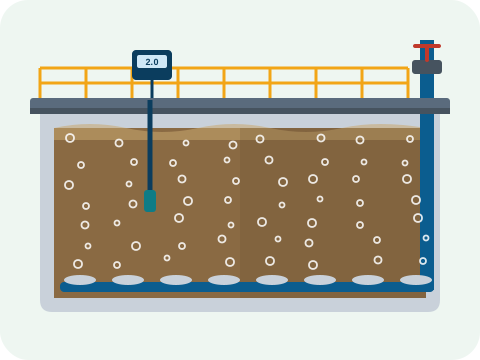
Activated sludge process control lab — Run an activated sludge plant day by day: aeration basins with blowers and DO probes, secondary clarifiers with sludge blanket, RAS and WAS. Do the daily F/M, MCRT, SVI…
Ventilation & airflow lab — Headworks, wet well, chlorine room, MCC/VFD room and lab fume hood with belt-driven fans, louvers, dampers, airflow proof, gas detectors & interlocks. Pitot traverses…
Shaft alignment & soft-foot lab — Align a horizontal pump and motor: LOTO, rough align, runout, pipe strain and soft-foot checks, then rim-and-face, reverse-dial or laser readings with sag correction…
Heating & combustion lab — Gas-fired pump-station unit heater (hot-surface ignition, inducer, pressure switch, flame sensor, LED codes) and a dual-fuel digester-building boiler (flame safeguard…
Motor control circuit troubleshooter — Animated ladder and power diagram of a submersible-pump starter bucket (CPT with fuses, 3-wire start/stop with seal-in, HOA, overload, seal/thermal relay, float…
Disinfection & chlorine lab — Gas chlorinator (vacuum regulator, rotameter, ejector) or hypochlorite metering pump, baffled clearwell or chlorine contact tank with bisulfite dechlorination, residual…
Multimeter & clamp-meter trainer — Realistic true-RMS DMM (rotary dial, auto-range, fused A/mA jacks, CAT ratings, LoZ) and clamp meters on a 480 V MCC bucket, a 120 V control circuit, a field junction…
Laboratory bench — Water & wastewater lab bench: pH meter calibration, DO air calibration and Winkler check, DPD chlorine, turbidimeter, alkalinity and hardness titrations, TSS/VSS solids…
4–20 mA loop & calibration lab — Two-wire transmitter loop with 24 VDC supply, IS barrier/isolator, cable resistance, JB, 250 Ω PLC input and HMI; documenting loop calibrator, hand pump with reference…
MCC bucket & motor testing lab — Lock out an FVNR bucket, then megger, winding-resistance, running-current/voltage-unbalance and thermography tests on a pump motor with randomized faults.
PID control & tuning sandbox — Real-time water/wastewater process simulation with a live trend and an ISA-style faceplate: bump tests, lambda tuning, integrating level loops, compound-loop…
Pump test bench & pump station — Centrifugal pump on a VFD with suction/discharge gauges, valves, flow meter, live pump & system curves (affinity laws, BEP, POR, NPSH3), cavitation, field faults, plus a…
Valve & Actuator Lab — Commission and troubleshoot electric MOVs (limits, torque, 4-20 mA deadband), calibrate a spring-return pneumatic valve with a smart positioner, exercise buried gate…
Course sequence: Wastewater Operator
3 numbered courses, 135 hours in total. Take them in order — each one prepares you for the next. Download the two-page sheet for any course.
WW 101Permits, Collection Systems & Primary Treatment
Foundation · 45 hours · 3 modules · 21 lessons · 9 3D simulators
Virginia licensing and VPDES permits, wastewater characteristics, collection and lift stations, headworks, and primary treatment and ponds.
Describe Virginia operator licensing and the VPDES permit: limits, sampling points, DMRs and reporting clocks.
Characterize wastewater (BOD, TSS, nutrients, temperature) and calculate loads and percent removal.
Explain collection-system layout, lift-station operation and H₂S/crown corrosion.
9 modules · 63 lessons · about 15 hours per module. Lesson 1 of every module is free with an account.
1Module 1: Virginia Licensing, Permits, Regulations & Utility Management
Module 1 · 7 lessons · ≈15 h
How Virginia licenses wastewater works operators (DPOR, 18VAC160-30), how DEQ classifies and staffs treatment works (9VAC25-790), and how VPDES permits, DMRs, noncompliance reporting, pretreatment, Chesapeake Bay nutrient limits, reuse and biosolids rules shape daily operation. Closes with the utility management skills tested on the Class 1 and 2 exams, plus compliance, CPE and budget math.
You will be able to:
Identify which agency and regulation governs operator licensing, plant design and staffing, discharge permits, reuse and biosolids in Virginia
State the experience, education, substitution and provisional-license rules for wastewater Classes 1 through 4
Apply application, exam, renewal (even-year February), reinstatement and CPE requirements, including utility management hours for Classes 1 and 2
Explain facility classification, reliability classes and recommended operator attendance under 9VAC25-790
Lessons
Who regulates Virginia wastewater & what a permit says Free sample
License classes, experience & substitutions
Applying, testing, renewing, CPE & conduct
DMRs, averages, records & noncompliance reports
Industrial pretreatment & Chesapeake Bay nutrients
Water reuse & biosolids rules
Plant class, staffing & utility management
2Module 2: Wastewater Characteristics, Collection Systems & Preliminary Treatment
Module 2 · 7 lessons · ≈15 h
What arrives at the headworks determines everything downstream. This unit covers wastewater sources and composition (BOD, COD, solids, nutrients, FOG, pathogens), flow patterns and peaking, infiltration and inflow, collection system types, manholes, lift stations, sulfide odor and crown corrosion, sewer inspection and cleaning, and flow measurement, then the preliminary treatment processes (screening, comminution…
You will be able to:
Describe the sources of municipal wastewater and contrast domestic and industrial discharges, including the pretreatment general and specific prohibitions.
Define BOD5, COD, TSS, VSS, settleable solids, TKN, phosphorus and FOG, and state typical medium-strength raw sewage values.
Explain diurnal flow patterns and peaking factors, and calculate loadings in lb/day and population equivalent.
Distinguish infiltration from inflow, estimate I&I from flow data, and describe SSO causes, response and DEQ reporting.
Lessons
What arrives at the plant: sources & characteristics Free with account
Flow patterns, loadings, I&I and overflows
Collection systems, manholes, cleaning & FOG
Lift stations & force mains
Hydrogen sulfide, odors & sewer corrosion
Flow measurement & screening
Grit, EQ, septage & headworks management
3Module 3: Primary Treatment, Ponds & Lagoons
Module 3 · 7 lessons · ≈15 h
Primary clarifiers remove settleable and floatable solids by gravity, typically 50–70% of TSS and 25–40% of BOD, ahead of secondary treatment; stabilization ponds and lagoons use algae, bacteria, sunlight, wind or mechanical aeration and long detention times to treat wastewater in small communities. This unit covers clarifier components, loading rates, sludge and scum handling, CEPT, troubleshooting, pond types and…
You will be able to:
Identify the components of rectangular and circular primary clarifiers and explain the purpose of each.
State typical primary removals of BOD and TSS and calculate percent removal.
Calculate detention time, surface overflow rate, weir overflow rate and solids loading, and interpret the results.
Set primary sludge pumping to obtain thick, fresh sludge and calculate sludge lb/day, gal/day and pump run time.
Lessons
Primary treatment basics & clarifier anatomy Free with account
Clarifier hydraulics, loading rates & operator math
Activated sludge is the most common secondary treatment process in Virginia and the heart of most WPI Wastewater Treatment exams. This unit covers the microbiology and indicator organisms, the major process variations, aeration and DO control, the control parameters (MLSS/MLVSS, F/M, MCRT, sludge age, SVI), RAS and WAS control, secondary clarifier operation, nitrification basics, and troubleshooting of bulking…
You will be able to:
Describe how the activated sludge process removes BOD and the roles of aeration, clarification, RAS and WAS.
Identify bacteria, protozoa and metazoa as indicators of sludge age and process health.
Fixed-film processes grow the treatment organisms as a biofilm on rock, plastic media, rotating discs or moving carriers, while SBRs, MBRs, IFAS and oxidation ditches extend activated sludge in compact or more flexible forms. This unit covers equipment, loading classification, recirculation, troubleshooting (ponding, flies, odors, icing, white RBC biomass, membrane fouling), and the operator math for hydraulic…
You will be able to:
Explain how a biofilm removes BOD and ammonia and why sloughing occurs.
Identify trickling filter components and compare rock and plastic media.
Classify trickling filters by hydraulic and organic loading and explain the purposes of recirculation.
Calculate TF hydraulic loading (gpd/ft² and gpm/ft²), organic loading, recirculation ratio and media volume.
Lessons
Fixed-film basics and trickling filter equipment Free with account
Trickling filter loading, recirculation and troubleshooting
Biotowers, TF/SC and nitrifying filters
Rotating biological contactors (RBCs)
Sequencing batch reactors (SBRs)
Membrane bioreactors (MBRs)
IFAS, MBBR, oxidation ditches, wetlands and selection
Virginia plants in the Chesapeake Bay watershed must remove nitrogen and phosphorus to very low levels before disinfecting and discharging. This unit covers the nitrogen cycle, nitrification and denitrification control, BNR configurations (MLE, Bardenpho, A2O, step-feed), biological and chemical phosphorus removal, ENR limits and nutrient load reporting, tertiary filtration, activated carbon and reuse, and…
You will be able to:
Describe the forms of nitrogen and phosphorus in wastewater and how TKN, TN and TP are defined.
Explain nitrification and denitrification and control SRT, DO, pH/alkalinity, temperature and carbon to keep them working.
Compare MLE, 4- and 5-stage Bardenpho, A2O, UCT/VIP and step-feed BNR, and calculate internal recycle needs.
Why nutrients matter: nitrogen & phosphorus basics Free with account
Nitrification & denitrification control
BNR configurations & internal recycle
Phosphorus removal: biological & chemical
Bay nutrient limits, loads & tertiary treatment
Chlorination, dechlorination & TRC
UV, ozone, PAA, bacteria limits & troubleshooting
7Module 7: Solids Handling, Digestion & Biosolids
Module 7 · 7 lessons · ≈15 h
Sludge removed in primary and secondary treatment must be thickened, stabilized, dewatered and then beneficially used or disposed of. This unit covers sludge characteristics, gravity and mechanical thickening, polymer conditioning, anaerobic and aerobic digestion, lime stabilization and composting, dewatering, the 40 CFR 503 pathogen, vector-attraction and pollutant requirements, and Virginia's DEQ biosolids…
You will be able to:
Describe the sources and typical solids and volatile-solids content of primary, waste activated, chemical and digested sludges.
Convert between sludge volume, wet weight and dry pounds using percent solids and the pounds formula.
Operate and troubleshoot gravity thickeners, DAF, gravity belt and rotary drum thickeners and centrifuges, including loading calculations.
Select and adjust polymer conditioning and calculate polymer dose in lb per dry ton.
Lessons
Sludge Types, Solids Math and the Solids Train Free with account
Thickening and Polymer Conditioning
Anaerobic Digestion: Biology and Process Control
Digester Equipment, Gas Safety and Troubleshooting
Aerobic Digestion, Lime, Composting and Class A/B
Dewatering: Presses, Centrifuges and Drying Beds
Land Application, Virginia Rules, Records and Safety
8Module 8: Laboratory Analysis, Sampling & Process Monitoring
Module 8 · 7 lessons · ≈15 h
Compliance and process-control decisions are only as good as the samples and lab results behind them. This unit covers representative sampling (grab and flow-proportional composites), 40 CFR 136 preservation and holding times, chain of custody and Virginia VELAP lab certification, the core wastewater tests (BOD/CBOD, COD, solids, settleometer, DO, pH, TRC, nutrients, E. coli and enterococci, microscopy, sludge…
You will be able to:
Select grab or composite sampling and appropriate sample points for each permit parameter.
Apply 40 CFR 136 Table II preservation, container and holding-time requirements.
Complete and maintain chain-of-custody and lab records; explain VELAP certification in Virginia.
Perform and calculate seeded and unseeded BOD5/CBOD5 and apply the test's QC criteria.
Lessons
Sampling, preservation & chain of custody Free with account
BOD5 and CBOD5: procedure, seeding & QC
COD, solids tests & process-control monitoring
Field tests: DO, pH, temperature & chlorine residual
Pumps, blowers, motors and valves move every gallon and cubic foot of air through a wastewater plant, and the operator who understands hydraulics, pump curves and maintenance keeps them running efficiently. The other half of this unit is safety: confined spaces, hydrogen sulfide, lockout/tagout, chlorine and digester gas, biological hazards, trenching, traffic, falls, security and VOSH recordkeeping, together with…
You will be able to:
Convert between pressure and head and apply Q = A × V and continuity to pipes and channels.
Calculate TDH, water/brake/motor horsepower, wire-to-water efficiency, kW and energy cost.
Determine pump capacity from wet-well drawdown tests, with and without inflow.
Select and operate wastewater pumps, including non-clog, submersible, vortex, progressive cavity, plunger, diaphragm, air-lift and screw pumps.
Lessons
Hydraulics and pumping math at the lift station Free with account
Pump types, curves, affinity laws and cavitation
Pump maintenance, motors, VFDs, blowers and mixers
Valves, flow meters, SCADA and maintenance management
Confined space entry and sewer gas hazards
LOTO, chemicals, gases, biohazards, PPE and fire
Trenching, traffic, falls, emergencies, security and records
Editions & standards
WPI Wastewater Treatment (Class I–IV)
DPOR 18VAC160-30
VPDES 9VAC25-31
9VAC25-790
40 CFR 503
Prepared with AI assistance. Training only — verify against current DPOR, VDH/DEQ and EPA requirements, your permit, your plant’s SOPs and the manufacturer’s instructions.
Exam prep for Classes 4 through 1
Timed mock exams mirror the structure of the WPI exams Virginia uses: 100 questions in 240 minutes, weighted by content domain for the license class you choose, with a review screen and score history.
Purchases are completed securely in the Academy portal after you sign in; the price shown at checkout applies. Team and utility seats: support@tryetech.com.
Frequently asked questions
Who is the Wastewater Operator course for?
It is written for two groups at once: operators-in-training and Class 4 candidates preparing for their first Virginia wastewater license get plain-language explanations of every term, and licensed operators moving up to Class 3, 2 or 1 and operators earning renewal continuing-education hours get code and standard references, field tips and harder scenarios. No prerequisites are required.
Does it prepare me for the Virginia operator exam?
Yes. The 9 modules follow the WPI Wastewater Treatment content domains used for Virginia licenses, Classes 4 through 1. A 3,500-question bank ramps from easy to exam-style, and timed mock exams (100 questions, 240 minutes) are weighted to each class. Passing a practice exam does not guarantee a passing score on the real exam.
Can I try it for free?
Yes. Lesson 1 of Module 1 opens without an account. A free account unlocks Lesson 1 of every module, one complete trial module and the operator tools (Math Lab, SDS library, calculators). Full access unlocks every lesson, lab, flashcard deck and certificate.
How many hours is the course, and does it count for CEUs?
Plan on about 135 hours (≈15 hours per module across 9 modules and 63 lessons), roughly 13.5 CEUs at 10 contact hours per CEU. The Academy records your active study time and issues module certificates with contact hours; whether they count is up to your licensing board or employer.
Which code and standard editions does it follow?
The course is written to: WPI Wastewater Treatment (Class I–IV) · DPOR 18VAC160-30 · VPDES 9VAC25-31 · 9VAC25-790 · 40 CFR 503. Each lesson cites the edition it uses. Always verify against the editions your authority having jurisdiction or regulator enforces.
Does it work on a phone or tablet in the plant?
Yes. The course runs in any modern browser on a phone, tablet or desktop, follows your light or dark setting, is fully keyboard accessible and keeps your place between devices when you are signed in.
Do I get a certificate?
You earn a module certificate when all lessons in a module are complete and the module quizzes average 80% or better. Each certificate lists your active study hours and a verification code anyone can check on the Academy site.
How do I buy full access or seats for my team?
Create a free account, then choose full access in the Academy portal. Utilities and contractors can contact support@tryetech.com for organization seats and verified email-domain access.
Start with a free lesson
See how the course works before you create an account — Module 1, Lesson 1 opens right away.