I&C Training for Water & Wastewater Plants and Systems
From the sensor to the SCADA screen — measurement, analyzers, control loops, PLCs and the data regulators rely on.
I&C Training for Water & Wastewater Plants and Systems is an online, self-paced course from TRYeTECH Academy covering pressure, level, temperature and flow measurement, water-quality analyzers, loop wiring, control valves, PID tuning, PLCs, SCADA and OT cybersecurity. It has 10 modules and 70 lessons — about 150 hours of study — and every lesson combines narrated slides with Key details, pre-task checklists, troubleshooting scenarios, hands-on practice labs, worked examples, quizzes and flashcards.
For new I&C technicians, electricians moving into instrumentation and operators who calibrate field instruments. Every term is explained in plain language, each lesson opens with a pre-task checklist and the scenarios build safe troubleshooting habits from day one.
Experienced & licensed
For senior I&C technicians, SCADA and controls specialists and engineers. You get code and standard references, numbers you can use in the field, pro-level scenarios and tracked active hours for CEU/continuing-education records.
What’s included
Narrated lesson slides
4,408 slides with speaker notes, 113 labeled technical figures and 734 worked examples.
Key details
Expandable “Key details” on 2,098 slides: the beginner explanation, the professional depth and a field tip.
Pre-task checklists
70 field checklists — plan, hazards & PPE, isolate & verify, tools, do the work, restore & document.
Troubleshooting scenarios
350 interactive scenarios: pick your tests, read the results, choose the root cause and see the fix.
Practice labs
6 hands-on simulators with guided presets tied to specific lessons (listed below).
Calculators & tools
Engineering calculator, Unit converter, Volume & area.
Technical whiteboard
Sketch circuits, P&IDs and calculations next to the lesson.
Flashcards
10,000 flashcards with spaced review across every module.
Lesson quizzes
468 quiz questions with explanations inside the lessons.
Progress & certificates
Active-time tracking, module certificates with contact hours and public verification codes.
Practice labs in this course
Motor control circuit troubleshooter — Animated ladder and power diagram of a submersible-pump starter bucket (CPT with fuses, 3-wire start/stop with seal-in, HOA, overload, seal/thermal relay, float…
Multimeter & clamp-meter trainer — Realistic true-RMS DMM (rotary dial, auto-range, fused A/mA jacks, CAT ratings, LoZ) and clamp meters on a 480 V MCC bucket, a 120 V control circuit, a field junction…
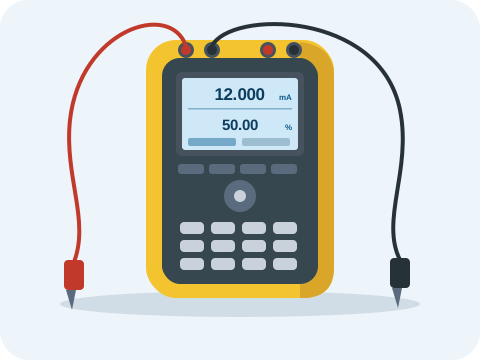
4–20 mA loop & calibration lab — Two-wire transmitter loop with 24 VDC supply, IS barrier/isolator, cable resistance, JB, 250 Ω PLC input and HMI; documenting loop calibrator, hand pump with reference…
PID control & tuning sandbox — Real-time water/wastewater process simulation with a live trend and an ISA-style faceplate: bump tests, lambda tuning, integrating level loops, compound-loop…
Pump test bench & pump station — Centrifugal pump on a VFD with suction/discharge gauges, valves, flow meter, live pump & system curves (affinity laws, BEP, POR, NPSH3), cavitation, field faults, plus a…
Valve & Actuator Lab — Commission and troubleshoot electric MOVs (limits, torque, 4-20 mA deadband), calibrate a spring-return pneumatic valve with a smart positioner, exercise buried gate…
Course sequence: Instrumentation & Controls
3 numbered courses, 150 hours in total. Take them in order — each one prepares you for the next. Download the two-page sheet for any course.
IC 101Measurement Fundamentals: Pressure, Level, Temperature, Flow & Analyzers
Foundation · 60 hours · 4 modules · 28 lessons · 12 3D simulators
How every common plant sensor works, how to install it correctly and how to read what it tells you.
Read ISA-5.1 tags, P&IDs and loop diagrams and keep instrument documentation current.
Select and install pressure, hydrostatic, differential-pressure, ultrasonic and radar level instruments.
Explain magnetic, ultrasonic, vortex, Coriolis and differential-pressure flow measurement and their straight-run requirements.
What an I&C technician does in water and wastewater, from the sensor in the wet well to the number on the regulatory report. The module covers the control loop, ISA-5.1 symbols and tag numbers, loop diagrams and documentation, 4-20 mA scaling math, safe work in mixed-voltage control panels and confined spaces, test equipment and traceability, and the data-integrity rules that protect compliance data.
You will be able to:
Trace the measure-transmit-control-record path through a water plant and a wastewater plant and name the measured variable at each stage.
Identify the sensor, transmitter, controller and final control element in a closed loop and explain how feedback works.
Decode ISA-5.1 tag numbers by first letter, modifiers and succeeding letters, and explain why letters describe function, not construction.
Read instrument bubbles and signal line types on P&IDs of a gravity filter, a chlorine contact basin and a lift station.
Lessons
The I&C technician in water & wastewater Free sample
ISA-5.1 symbols & tag numbers
Loop diagrams, instrument index & documentation
Units, signals & scaling math
Safety for I&C work
Tools & test equipment
Regulatory data & data integrity
2Module 2: Pressure, Level & Temperature Measurement
Module 2 · 7 lessons · ≈15 h
This module covers how water and wastewater plants measure pressure, level and temperature, from Bourdon gauges and DP transmitters to submersible transducers, bubblers, radar, floats, thermocouples and RTDs. It ties every measurement to its process job — wet-well pump control, clearwell CT, storage-tank pressure zones, chemical inventory, filters and digesters — and to the math behind it. It closes with safe…
You will be able to:
Distinguish gauge, absolute, differential and vacuum pressure and convert among psi, inH2O, inHg, kPa and feet of water.
Select, install and protect pressure gauges with the right range, accuracy grade, snubber, seal and isolation valve.
Explain how capacitive and piezoresistive pressure and DP transmitters work and set range, turndown and damping correctly.
Operate 3- and 5-valve manifolds safely and install impulse lines for liquid, gas and dirty services with freeze protection.
Lessons
Pressure fundamentals & gauges Free with account
Pressure & DP transmitters
Hydrostatic level
Non-contact & point level
Level applications
Temperature measurement
Troubleshooting pressure, level & temperature instruments
3Module 3: Flow Measurement
Module 3 · 7 lessons · ≈15 h
How water and wastewater plants measure flow in full pipes, open channels and air and gas headers, and how to keep those numbers accurate enough to report. The module covers flow fundamentals, magnetic, differential-pressure, ultrasonic, Coriolis, vortex, turbine and thermal mass meters, Parshall flumes and weirs, and the verification, calibration and troubleshooting work that keeps production and VPDES discharge…
You will be able to:
Explain velocity profile, Reynolds number, straight-run requirements and why installation sets most of a flowmeter's real accuracy.
Distinguish accuracy, repeatability, turndown and % of rate versus % of full-scale specifications and apply them to a meter choice.
Convert among gpm, MGD, cfs and gallons per pulse, and set up and check totalizers and pulse outputs for regulatory flow records.
Describe magnetic flowmeter operation under Faraday's law and select liners, electrodes, grounding rings and meter size for raw water, sludge and chemical service.
Lessons
Flow fundamentals Free with account
Magnetic flowmeters
DP flow
Ultrasonic & other closed-pipe meters
Open-channel flow
Air & gas flow
Flow verification, calibration & troubleshooting
4Module 4: Water Quality Analyzers
Module 4 · 7 lessons · ≈15 h
Online analyzers turn water quality into the numbers that run the plant and prove compliance: chlorine residual, turbidity, pH, DO, nutrients, fluoride, UVT and more. This module covers how analyzer systems are sampled, conditioned, calibrated, verified and maintained, and the measurement principles behind each analyzer. Throughout, data integrity comes first: calibrated against standards, verified with grab…
You will be able to:
Select and evaluate analyzer sample points and calculate sample line lag time.
Specify sample conditioning and drain arrangements, including air gaps and reagent waste handling.
Distinguish calibration from verification and perform documented grab-sample comparisons.
Explain free, combined and total chlorine and the effect of pH on HOCl and on sensor response.
How analog and discrete signals carry the plant's measurements and commands from wet wells, filters and analyzers to the PLC and SCADA, and how to keep those signals honest. The module covers 4–20 mA loops and power budgets, NE 43 fault levels, discrete I/O and relays, HART and fieldbus, panel wiring under the 2020 NEC and UL 508A, grounding, shielding, surge and noise control, intrinsic safety in wet wells and…
You will be able to:
Explain why 4–20 mA with a live zero is the standard analog signal in water and wastewater plants.
Wire and identify 2-, 3- and 4-wire transmitters and match active and passive devices.
Calculate loop power budgets, cable resistance and maximum loop resistance at 22 mA.
Scale and reverse-scale 4–20 mA and 1–5 V signals and apply NAMUR NE 43 fault levels.
Lessons
Analog signals Free with account
Discrete signals & relays
HART & digital fieldbus
Wiring practices & panel construction
Grounding, shielding & noise
Intrinsic safety & hazardous areas for I&C
Loop checks & signal troubleshooting
6Module 6: Final Control Elements
Module 6 · 7 lessons · ≈15 h
Final control elements are the muscle of every loop: the control valves, actuators, positioners, electric actuators, VFDs and chemical metering pumps that actually change flow, level, pressure and dose in water and wastewater plants. This module covers how to choose, size, set up, calibrate and troubleshoot them, including Cv math, characteristics, cavitation, fail-safe action, instrument air, speed references and…
You will be able to:
Identify the final control elements used in water and wastewater plants and explain their role in a control loop.
Select fail-closed, fail-open or fail-last action from the process hazard and document it on the P&ID and narrative.
Compare linear, equal-percentage and quick-opening characteristics and explain rangeability and installed characteristic.
Describe globe, butterfly, ball, segmented ball and plug valves and match them to water and wastewater services.
Lessons
Final control elements overview Free with account
Control valves
Actuators & positioners
Electric valve actuators for control
VFDs & pumps as final elements
Valve & actuator calibration/setup
Final element troubleshooting
7Module 7: Process Control & PID Tuning
Module 7 · 7 lessons · ≈15 h
This module teaches how water and wastewater processes behave and how controllers hold them on setpoint, from on-off pump control to PID and advanced strategies such as cascade, ratio, feedforward and compound-loop chlorination. Technicians learn to run safe bump tests, apply lambda tuning to flow and level loops, and apply these skills to filters, clearwells, chlorine residual, lift stations, aeration and RAS/WAS.…
You will be able to:
Describe a feedback control loop in terms of PV, SP, error, controller output and final element, using water and wastewater examples.
Distinguish open-loop, on-off (with deadband) and modulating closed-loop control and choose the right one for a given process.
Characterize process dynamics by process gain, dead time and time constant, and tell self-regulating from integrating processes.
Explain proportional, integral and derivative action, including gain vs proportional band and repeats/min vs min/repeat.
Lessons
Control fundamentals Free with account
PID explained
Tuning methods
Advanced strategies
Water treatment control applications
Wastewater control applications
Control loop performance & troubleshooting
8Module 8: PLCs, HMIs & Control Programming
Module 8 · 7 lessons · ≈15 h
This module takes the I&C technician inside the programmable logic controller and the operator interface that run treatment plants, pump stations and wells: hardware and architecture, IEC 61131-3 languages, the core logic patterns of water and wastewater, sequences and interlocks, ISA-101 HMI design, commissioning and change management, and safe PLC troubleshooting. Every topic is tied back to safe states, data…
You will be able to:
Identify PLC hardware components (CPU, power supply, discrete/analog/specialty I/O, remote I/O, communication modules) and explain the scan cycle and watchdog.
Compare simplex, hot-standby and I/O redundancy options and size a 24 VDC supply and panel UPS for a remote pump station.
Describe firmware, memory (retentive vs non-retentive) and backup practices that keep a PLC recoverable after failure.
Read and write simple logic in ladder, function block diagram, structured text and sequential function charts per IEC 61131-3, using correct data types.
Lessons
PLC hardware & architecture Free with account
IEC 61131-3 programming languages
Core logic patterns for water/wastewater
Sequences & interlocks
HMI design
Testing, commissioning & change management
PLC troubleshooting
9Module 9: SCADA, Telemetry, Networks & OT Cybersecurity
Module 9 · 7 lessons · ≈15 h
How a utility SCADA system gathers data from wells, tanks, pump and lift stations and treatment plants, moves it over radio, cellular and fiber links using Modbus, DNP3, EtherNet/IP and OPC UA, and stores it in historians that feed regulatory reports. The module covers industrial networking and subnetting, link-budget and polling math, ISA/IEC 62443 zones and conduits, AWIA risk and resilience duties, and ISA-18.2…
You will be able to:
Describe a utility SCADA architecture (servers, HMIs, historians, RTUs/PLCs, communications) and place each component on the Purdue model levels.
Compare redundancy and virtualization options for SCADA servers and explain what each protects against and what it does not.
Select a telemetry medium (licensed or unlicensed radio, cellular, fiber, leased line) for a remote site and justify the choice by reliability, bandwidth, cost and security.
Calculate free-space path loss, link budget, fade margin and Fresnel-zone clearance for a radio path, and size an RTU battery for a stated autonomy.
Lessons
SCADA architecture for utilities Free with account
The capstone module covers how a water or wastewater utility keeps its instruments right, starts systems up correctly, and finds faults fast. You will build a risk-based calibration program with traceable standards and honest as-found records, do the calibration and verification math for transmitters, analyzers and flowmeters, run commissioning from FAT to turnover, and troubleshoot by evidence. Safety and…
You will be able to:
Define calibration, adjustment, verification and loop check, and explain why as-found data is recorded first.
Build a calibration program with criticality classes, risk-based intervals, written tolerances and CMMS scheduling.
Compute test uncertainty ratio and choose a reference standard that meets 4:1 at the test point.
Explain NIST traceability, ISO/IEC 17025 accreditation, certificate due dates and reverse traceability.
Lessons
Calibration program Free with account
Calibration math & methods
Analyzer & flowmeter verification programs
Commissioning & startup
Troubleshooting methodology for I&C
Reliability & maintenance strategy
Case studies & emergency response
Editions & standards
ISA-5.1/18.2/62443
IEC 61131-3
2020 NEC (Art. 504/725/409)
40 CFR 141
12VAC5-590
NFPA 70E-2024
Prepared with AI assistance. Training only — verify against current standards, your permits and regulators’ requirements, your facility’s safety programs and manufacturer instructions.
Purchases are completed securely in the Academy portal after you sign in; the price shown at checkout applies. Team and utility seats: support@tryetech.com.
Frequently asked questions
Who is the Instrumentation & Controls course for?
It is written for two groups at once: new I&C technicians, electricians moving into instrumentation and operators who calibrate field instruments get plain-language explanations of every term, and senior I&C technicians, SCADA and controls specialists and engineers get code and standard references, field tips and harder scenarios. No prerequisites are required.
Can I try it for free?
Yes. Lesson 1 of Module 1 opens without an account. A free account unlocks Lesson 1 of every module. Full access unlocks every lesson, lab, flashcard deck and certificate.
How many hours is the course, and does it count for CEUs?
Plan on about 150 hours (≈15 hours per module across 10 modules and 70 lessons), roughly 15 CEUs at 10 contact hours per CEU. The Academy records your active study time and issues module certificates with contact hours; whether they count is up to your licensing board or employer.
Which code and standard editions does it follow?
The course is written to: ISA-5.1/18.2/62443 · IEC 61131-3 · 2020 NEC (Art. 504/725/409) · 40 CFR 141 · 12VAC5-590 · NFPA 70E-2024. Each lesson cites the edition it uses. Always verify against the editions your authority having jurisdiction or regulator enforces.
Does it work on a phone or tablet in the plant?
Yes. The course runs in any modern browser on a phone, tablet or desktop, follows your light or dark setting, is fully keyboard accessible and keeps your place between devices when you are signed in.
Do I get a certificate?
You earn a module certificate when all lessons in a module are complete and the module quizzes average 80% or better. Each certificate lists your active study hours and a verification code anyone can check on the Academy site.
How do I buy full access or seats for my team?
Create a free account, then choose full access in the Academy portal. Utilities and contractors can contact support@tryetech.com for organization seats and verified email-domain access.
Start with a free lesson
See how the course works before you create an account — Module 1, Lesson 1 opens right away.