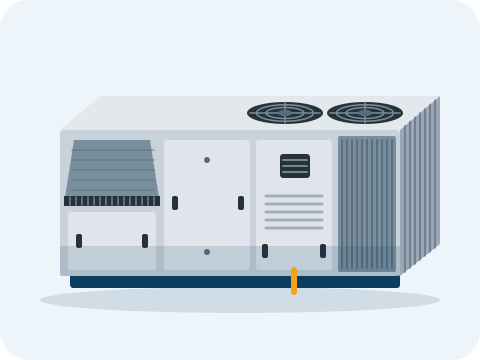
HVAC & Refrigeration Training for Water and Wastewater Treatment Plants
Heating, ventilation, air conditioning and refrigeration for treatment plants — chemical rooms, wet wells, MCC rooms, labs and boilers on digester gas.
HVAC & Refrigeration Training for Water and Wastewater Treatment Plants is an online, self-paced course from TRYeTECH Academy covering psychrometrics, the refrigeration cycle, air handling, hazardous-space ventilation, heating, chillers and hydronics, controls and building automation. It has 10 modules and 70 lessons — about 150 hours of study — and every lesson combines narrated slides with Key details, pre-task checklists, troubleshooting scenarios, hands-on practice labs, worked examples, quizzes and flashcards.
For HVAC-R apprentices, building-maintenance staff and operators responsible for plant ventilation. Every term is explained in plain language, each lesson opens with a pre-task checklist and the scenarios build safe troubleshooting habits from day one.
Experienced & licensed
For licensed HVAC-R technicians, facilities supervisors and mechanical engineers. You get code and standard references, numbers you can use in the field, pro-level scenarios and tracked active hours for CEU/continuing-education records.
What’s included
Narrated lesson slides
4,371 slides with speaker notes, 114 labeled technical figures and 628 worked examples.
Key details
Expandable “Key details” on 2,184 slides: the beginner explanation, the professional depth and a field tip.
Pre-task checklists
70 field checklists — plan, hazards & PPE, isolate & verify, tools, do the work, restore & document.
Troubleshooting scenarios
350 interactive scenarios: pick your tests, read the results, choose the root cause and see the fix.
Practice labs
11 hands-on simulators with guided presets tied to specific lessons (listed below).
Calculators & tools
Engineering calculator, Unit converter, Volume & area.
Flashcards
10,000 flashcards with spaced review across every module.
Lesson quizzes
464 quiz questions with explanations inside the lessons.
Progress & certificates
Active-time tracking, module certificates with contact hours and public verification codes.
Practice labs in this course
Ventilation & airflow lab — Headworks, wet well, chlorine room, MCC/VFD room and lab fume hood with belt-driven fans, louvers, dampers, airflow proof, gas detectors & interlocks. Pitot traverses…
Shaft alignment & soft-foot lab — Align a horizontal pump and motor: LOTO, rough align, runout, pipe strain and soft-foot checks, then rim-and-face, reverse-dial or laser readings with sag correction…
Heating & combustion lab — Gas-fired pump-station unit heater (hot-surface ignition, inducer, pressure switch, flame sensor, LED codes) and a dual-fuel digester-building boiler (flame safeguard…
Motor control circuit troubleshooter — Animated ladder and power diagram of a submersible-pump starter bucket (CPT with fuses, 3-wire start/stop with seal-in, HOA, overload, seal/thermal relay, float…
Multimeter & clamp-meter trainer — Realistic true-RMS DMM (rotary dial, auto-range, fused A/mA jacks, CAT ratings, LoZ) and clamp meters on a 480 V MCC bucket, a 120 V control circuit, a field junction…
4–20 mA loop & calibration lab — Two-wire transmitter loop with 24 VDC supply, IS barrier/isolator, cable resistance, JB, 250 Ω PLC input and HMI; documenting loop calibrator, hand pump with reference…
MCC bucket & motor testing lab — Lock out an FVNR bucket, then megger, winding-resistance, running-current/voltage-unbalance and thermography tests on a pump motor with randomized faults.
PID control & tuning sandbox — Real-time water/wastewater process simulation with a live trend and an ISA-style faceplate: bump tests, lambda tuning, integrating level loops, compound-loop…
Pump test bench & pump station — Centrifugal pump on a VFD with suction/discharge gauges, valves, flow meter, live pump & system curves (affinity laws, BEP, POR, NPSH3), cavitation, field faults, plus a…
Refrigeration diagnostics lab — Packaged rooftop units, split systems and an R-134a chiller serving plant MCC and control rooms: safety pre-work (608, PPE, A2L, LOTO), digital manifold hookup, the nine…
Valve & Actuator Lab — Commission and troubleshoot electric MOVs (limits, torque, 4-20 mA deadband), calibrate a spring-return pneumatic valve with a smart positioner, exercise buried gate…
Course sequence: HVAC for Water & Wastewater Plants
2 numbered courses, 150 hours in total. Take them in order — each one prepares you for the next. Download the two-page sheet for any course.
HVAC 101HVAC Foundations: Safety, Psychrometrics, Refrigeration, Air & Hazardous-Space Ventilation
Foundation · 75 hours · 5 modules · 35 lessons · 15 3D simulators
Everything you need to understand how plant HVAC works: codes, heat and moisture, the refrigeration cycle, air distribution and ventilation of classified spaces.
Work safely on HVAC equipment: LOTO, refrigerant release, wet-well and chemical-room atmospheres.
Navigate the 2021 Virginia USBC (IMC/IFGC/IECC) and NFPA 820 requirements for plant HVAC.
Use sensible and latent heat equations and plot processes on the psychrometric chart.
Boilers and furnaces, chilled- and hot-water systems, building controls, corrosion-resistant design and the maintenance and troubleshooting skills to keep plants comfortable and safe.
Explain combustion air, venting and backdrafting for gas-fired heating equipment and troubleshoot an ignition sequence.
10 modules · 70 lessons · about 15 hours per module. Lesson 1 of every module is free with an account.
1Module 1: HVAC Safety, Codes & the Plant HVAC Trade
Module 1 · 7 lessons · ≈15 h
What an HVAC technician does at water and wastewater plants, why ventilation and conditioning in those buildings are life-safety equipment, and which Virginia codes, NFPA, ASHRAE, OSHA and EPA rules govern the work. The module builds the safety habits every later module relies on: lockout of every energy source, refrigerant and 608 compliance, hazardous and corrosive atmospheres, fuel-gas and hot-work safety, the…
You will be able to:
Describe the plant HVAC technician's role and why ventilation in plant spaces is life-safety equipment.
Identify HVAC systems in headworks, wet and dry wells, chemical rooms, boiler rooms, MCC rooms, labs and remote stations.
Explain how the 2021 Virginia USBC, IMC, IFGC, IECC, NFPA 820, ASHRAE standards, Ten States, OSHA/VOSH and EPA 608 fit together.
Apply OSHA 1910.147 lockout/tagout to RTUs, AHUs, exhaust fans, chillers, boilers and unit heaters with multiple energy sources.
Lessons
HVAC at water & wastewater plants Free sample
Hazardous energy & electrical safety for HVAC work
Refrigerant safety & EPA Section 608
Hazardous & corrosive atmospheres
Combustion & fuel-gas safety
Tools, instruments & PPE
Documentation & work management
2Module 2: HVAC Fundamentals & Psychrometrics
Module 2 · 7 lessons · ≈15 h
The physics every plant HVAC technician uses daily: heat and energy, the psychrometric chart, airflow and pressure, heat-gain load estimates for process buildings, hydronic and steam basics, electricity for HVAC equipment, and how to read drawings and schedules. Every concept is tied to real water and wastewater spaces such as MCC rooms, pipe galleries, wet wells and chemical rooms, and every hands-on task starts…
You will be able to:
Explain heat, temperature, sensible heat, latent heat and specific heat, and convert between Btu/h, tons, kW and hp.
Describe conduction, convection and radiation and apply Q = U x A x dT to plant building surfaces.
Define dry bulb, wet bulb, dew point, relative humidity, humidity ratio, enthalpy and specific volume and locate them on a psychrometric chart.
Plot sensible heating, cooling and dehumidifying, humidifying and mixing processes and calculate mixed-air temperature and outdoor-air fraction.
Lessons
Heat, temperature & energy Free with account
Psychrometrics
Air properties & airflow
Heat gains & loads at plants
Hydronic & steam fundamentals
Electricity for HVAC technicians
Reading HVAC drawings & documents
3Module 3: Refrigeration Cycle & Refrigerants
Module 3 · 7 lessons · ≈15 h
How the vapor-compression cycle moves heat, and how refrigerants, oils, compressors, metering devices and accessories make it work in the RTUs, splits, mini-splits and chillers that cool plant control rooms, MCC rooms, labs and offices. The module builds from saturation, superheat, subcooling and the P-h diagram to EPA 608 and AIM Act refrigerant management, A2L handling, leak testing, evacuation and charging, and…
You will be able to:
Trace refrigerant through the evaporator, compressor, condenser and metering device and name the state change and pressure side at each point.
Use the pressure-temperature relationship to convert gauge pressure to saturation temperature, and explain where it does and does not apply.
Calculate superheat and subcooling and explain what each reveals about evaporator feed and liquid supply.
Read a basic P-h diagram and compute refrigerating effect, heat of compression, heat of rejection, COP and mass flow.
Lessons
The vapor-compression cycle Free with account
Refrigerants & oils
Compressors
Metering devices
Heat exchangers & system accessories
Leak testing, evacuation & charging
Refrigeration troubleshooting
4Module 4: Air Handling, Fans & Ductwork
Module 4 · 7 lessons · ≈15 h
Module 4 follows the air through a plant building: air handlers, rooftop units and make-up air units, the fans that move the air, and the ducts, dampers and filters that carry and clean it. You will learn to keep MCC rooms clean and positive, chemical rooms and headworks negative, and corrosive exhaust contained, then prove it with pitot traverses, capture hoods and balancing. The module ends with a safe, systematic…
You will be able to:
Identify the components of an AHU, RTU and make-up air unit and explain what each does in the airstream
Select corrosion-resistant construction (coated coils, stainless, aluminum, FRP) for H2S and chlorine exposure
Explain when and why exhaust-heavy plant spaces need tempered make-up air, and size the heating load
Compare FC, BI, airfoil, radial, plenum, axial and FRP fans and match each to a plant application
Lessons
Air handlers, RTUs & make-up air units Free with account
Fans
Ductwork & dampers
Filtration & gas-phase air cleaning
Air distribution & space pressurization
Testing, adjusting & balancing (TAB)
Air-side troubleshooting
5Module 5: Ventilation of Hazardous & Process Spaces
Module 5 · 7 lessons · ≈15 h
How to ventilate the plant spaces that can kill or corrode: wet wells, dry wells, headworks, chemical rooms, odor control systems, labs, battery rooms and electrical rooms. Learners apply the 2021 IMC (Virginia USBC), NFPA 820, ASHRAE 62.1, Ten States Standards and OSHA, compute ACH, purge, H2S loading, hood and heat loads, and test and troubleshoot ventilation safely.
You will be able to:
Explain how IMC Chapters 4 and 5, ASHRAE 62.1, NFPA 820, Ten States Standards and OSHA each govern ventilation of plant process spaces.
Calculate required CFM from air changes per hour and space volume, and estimate pre-entry purge time using a mixing factor.
Distinguish continuous ventilation that can reduce NFPA 820 classification from intermittent pre-entry ventilation that cannot.
Specify and verify airflow-failure monitoring that proves air movement rather than motor operation.
Lessons
Ventilation requirements Free with account
Headworks, wet wells, dry wells & pump stations
Chemical storage & feed rooms
Odor control systems
Laboratory & special ventilation
Electrical, MCC, VFD & control rooms
Ventilation testing & troubleshooting
6Module 6: Heating Systems
Module 6 · 7 lessons · ≈15 h
How water and wastewater plants keep pump stations, chemical rooms, process buildings and digesters warm: unit heaters, infrared, make-up air, boilers, electric heat and heat pumps, chosen for corrosive and classified spaces. The module covers gas ignition and controls, combustion air and venting, boiler safeties and hydronics, digester gas heating, combustion analysis and systematic heating troubleshooting, always…
You will be able to:
Select heating equipment for plant spaces, including classified, corrosive and remote freeze-prone stations.
Calculate envelope and ventilation heat loss and size electric or hydronic heaters for a pump station.
Explain standing pilot, intermittent pilot, direct spark and hot-surface ignition sequences and their safeties.
Measure flame rectification signal and inlet and manifold gas pressures safely and interpret the results.
Lessons
Heating at plants & stations Free with account
Gas-fired equipment
Boilers & hydronic heating
Digester gas (biogas) heating
Electric heat & heat pumps
Combustion analysis & efficiency
Heating troubleshooting
7Module 7: Chillers, Cooling Towers & Hydronic Systems
Module 7 · 7 lessons · ≈15 h
How plant cooling actually gets made and moved: chillers, cooling towers and fluid coolers, hydronic pumping and piping, and the split and ductless systems that protect MCC, VFD and SCADA rooms. You will size loads with real plant numbers, run the water-balance and Legionella side of towers, maintain chillers and loops under EPA 608 and ASHRAE 188, and troubleshoot head pressure, flow and freeze problems — always…
You will be able to:
Compare air-cooled and water-cooled chillers and scroll, screw, centrifugal and absorption compressors by capacity, efficiency and plant application.
Calculate chiller load, tons, kW/ton, COP and EER from log-sheet data.
Use evaporator and condenser approach temperatures to detect fouling, low charge and non-condensables.
Explain cooling tower types, range and approach, and why a tower cannot cool below the wet-bulb.
Lessons
Chillers Free with account
Cooling towers & evaporative equipment
Hydronic piping & pumps
Split, ductless & DX systems in plant buildings
Process & equipment cooling
Hydronic & chiller maintenance
Cooling system troubleshooting
8Module 8: HVAC Controls & Building Automation
Module 8 · 7 lessons · ≈15 h
Controls decide whether plant HVAC actually protects people, equipment and processes: they prove airflow in wet wells, purge chlorine rooms, keep MCC rooms cool and pressurized, and stop coils from freezing. This module builds from control loops and 24 V circuits through plant sequences of operation, DDC/BACnet/Modbus and VFDs to commissioning and troubleshooting, with OT cybersecurity and lockout of every energy…
You will be able to:
Explain open- and closed-loop control, setpoint, deadband, differential and P/PI action.
Select and verify temperature, RH, pressure, airflow, CO2 and gas sensors for corrosive plant spaces.
Choose fail-safe positions for valves, dampers and fans in plant HVAC systems.
Read 24 V and 120 V ladder diagrams and identify safeties wired in series.
Lessons
Control fundamentals Free with account
Thermostats & low-voltage control circuits
Sequences of operation for plant spaces
DDC & building automation
VFDs on fans & pumps
Controls checkout & commissioning
Controls troubleshooting
9Module 9: Corrosion, Energy & the Indoor Environment
Module 9 · 7 lessons · ≈15 h
Plant air is hard on equipment and people: hydrogen sulfide and chlorine destroy coils and electronics, galleries sweat, remote stations freeze, and ventilation never gets a day off. This module covers corrosion classes and defenses, energy management that never trades away safety ventilation, indoor air quality and comfort, humidity and freeze control, standby resilience, and commissioning that proves it all works.
You will be able to:
Explain how H2S, chlorine and chlorides attack copper, aluminum, steel and electronics in plant HVAC equipment.
Classify an electrical or control room with ISA-71.04 copper and silver coupon results (G1–GX).
Select corrosion defenses: siting, pressurization with gas-phase filtration, coil coatings, stainless, FRP and PVC-coated materials.
Calculate kWh, kW and dollar savings for higher-efficiency equipment and VFD fans using EER and the fan laws.
Lessons
Corrosion of HVAC equipment at plants Free with account
Energy management
Indoor air quality & comfort
Humidity & condensation control
Freeze protection & winterization
Emergency, standby & resilience
Commissioning & retro-commissioning
10Module 10: HVAC Maintenance, Troubleshooting & Professional Practice
Module 10 · 7 lessons · ≈15 h
This capstone module turns system knowledge into reliable plant practice: building condition-based preventive maintenance programs in a CMMS, troubleshooting systematically, and diagnosing the electrical and mechanical faults that stop HVAC equipment at water and wastewater facilities. Plant case studies, contractor and licensing requirements under Virginia DPOR, EPA 608 and the 2021 USBC, and professional ethics…
You will be able to:
Build a condition-based PM program using ASHRAE/ACCA Standard 180 concepts: inventory, tasks, frequencies, condition indicators and records.
Rank plant HVAC assets by criticality (consequence x likelihood) and set PM intervals, redundancy and spares to match.
Organize PM routes, meter-based work orders and failure codes in a CMMS and track PM compliance.
Apply a systematic troubleshooting sequence: safety first, verify the complaint, gather data, compare sequence of operation, half-split, fix root cause, verify and document.
Lessons
Preventive maintenance programs Free with account
Systematic troubleshooting
Electrical troubleshooting of HVAC equipment
Mechanical troubleshooting
Plant case studies
Contractors, specifications & licensing
Professional practice & course wrap-up
Editions & standards
2021 IMC/IFGC/IECC (Virginia USBC)
NFPA 820-2024
ASHRAE 15/34/62.1
EPA Section 608 & AIM Act
OSHA/VOSH
Prepared with AI assistance. Training only — verify against the code editions your building official enforces, NFPA 820, EPA refrigerant rules, your facility’s safety program and manufacturer instructions.
Purchases are completed securely in the Academy portal after you sign in; the price shown at checkout applies. Team and utility seats: support@tryetech.com.
Frequently asked questions
Who is the HVAC for Water & Wastewater Plants course for?
It is written for two groups at once: HVAC-R apprentices, building-maintenance staff and operators responsible for plant ventilation get plain-language explanations of every term, and licensed HVAC-R technicians, facilities supervisors and mechanical engineers get code and standard references, field tips and harder scenarios. No prerequisites are required.
Can I try it for free?
Yes. Lesson 1 of Module 1 opens without an account. A free account unlocks Lesson 1 of every module. Full access unlocks every lesson, lab, flashcard deck and certificate.
How many hours is the course, and does it count for CEUs?
Plan on about 150 hours (≈15 hours per module across 10 modules and 70 lessons), roughly 15 CEUs at 10 contact hours per CEU. The Academy records your active study time and issues module certificates with contact hours; whether they count is up to your licensing board or employer.
Which code and standard editions does it follow?
The course is written to: 2021 IMC/IFGC/IECC (Virginia USBC) · NFPA 820-2024 · ASHRAE 15/34/62.1 · EPA Section 608 & AIM Act · OSHA/VOSH. Each lesson cites the edition it uses. Always verify against the editions your authority having jurisdiction or regulator enforces.
Does it work on a phone or tablet in the plant?
Yes. The course runs in any modern browser on a phone, tablet or desktop, follows your light or dark setting, is fully keyboard accessible and keeps your place between devices when you are signed in.
Do I get a certificate?
You earn a module certificate when all lessons in a module are complete and the module quizzes average 80% or better. Each certificate lists your active study hours and a verification code anyone can check on the Academy site.
How do I buy full access or seats for my team?
Create a free account, then choose full access in the Academy portal. Utilities and contractors can contact support@tryetech.com for organization seats and verified email-domain access.
Start with a free lesson
See how the course works before you create an account — Module 1, Lesson 1 opens right away.