Nine units for the Virginia Waterworks Operator license, Classes 4 through 1 — slides, labs, checklists, troubleshooting scenarios, 3,500 explained questions and timed WPI-style exams.
Virginia Waterworks Operator Prep (Class 4–1) is an online, self-paced course from TRYeTECH Academy covering regulations, source water, coagulation, filtration, disinfection, corrosion control, lab analysis, equipment and safety. It has 9 modules and 61 lessons — about 135 hours of study — and every lesson combines narrated slides with Key details, pre-task checklists, troubleshooting scenarios, hands-on practice labs, worked examples, quizzes and flashcards, backed by a 3,500-question bank and timed WPI-style mock exams for Classes 4 through 1.
For operators-in-training and Class 4 candidates preparing for their first Virginia waterworks license. Every term is explained in plain language, each lesson opens with a pre-task checklist and the scenarios build safe troubleshooting habits from day one.
Experienced & licensed
For licensed operators moving up to Class 3, 2 or 1 and operators earning renewal continuing-education hours. You get code and standard references, numbers you can use in the field, pro-level scenarios and tracked active hours for CEU/continuing-education records.
What’s included
Narrated lesson slides
3,163 slides with speaker notes, 29 labeled technical figures and 527 worked examples.
Key details
Expandable “Key details” on 1,600 slides: the beginner explanation, the professional depth and a field tip.
Pre-task checklists
61 field checklists — plan, hazards & PPE, isolate & verify, tools, do the work, restore & document.
Troubleshooting scenarios
315 interactive scenarios: pick your tests, read the results, choose the root cause and see the fix.
Practice labs
12 hands-on simulators with guided presets tied to specific lessons (listed below).
Calculators & tools
Engineering calculator, Unit converter, Formula Studio, Math Lab, SDS library, Volume & area.
Flashcards
4,000 flashcards with spaced review across every module.
Question bank & timed exams
3,500 explained questions that ramp from easy to exam-style, plus timed 100-question, 240-minute mock exams for each license class (4 to 1).
Progress & certificates
Active-time tracking, module certificates with contact hours and public verification codes.
Practice labs in this course
Shaft alignment & soft-foot lab — Align a horizontal pump and motor: LOTO, rough align, runout, pipe strain and soft-foot checks, then rim-and-face, reverse-dial or laser readings with sag correction…
Motor control circuit troubleshooter — Animated ladder and power diagram of a submersible-pump starter bucket (CPT with fuses, 3-wire start/stop with seal-in, HOA, overload, seal/thermal relay, float…
Disinfection & chlorine lab — Gas chlorinator (vacuum regulator, rotameter, ejector) or hypochlorite metering pump, baffled clearwell or chlorine contact tank with bisulfite dechlorination, residual…
Multimeter & clamp-meter trainer — Realistic true-RMS DMM (rotary dial, auto-range, fused A/mA jacks, CAT ratings, LoZ) and clamp meters on a 480 V MCC bucket, a 120 V control circuit, a field junction…
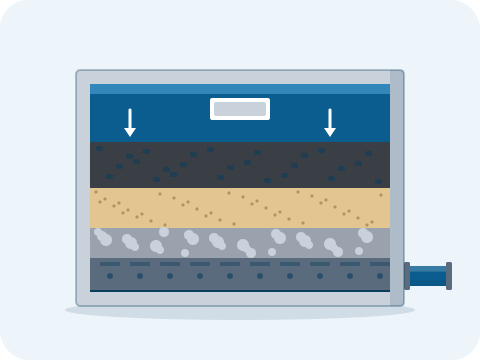
Filter operations & backwash lab — Dual-media rapid gravity filter in section with its console (ROFC, head loss, IFE, flow) and backwash system: time-lapse filter runs, when-to-wash decisions, a full…
Jar test lab — Six-place gang stirrer jar test: raw-water sample, alum / ferric chloride / PACl, polymer aid and lime or caustic stocks, calibrated turbidimeter and pH meter, rapid…
Laboratory bench — Water & wastewater lab bench: pH meter calibration, DO air calibration and Winkler check, DPD chlorine, turbidimeter, alkalinity and hardness titrations, TSS/VSS solids…
4–20 mA loop & calibration lab — Two-wire transmitter loop with 24 VDC supply, IS barrier/isolator, cable resistance, JB, 250 Ω PLC input and HMI; documenting loop calibrator, hand pump with reference…
MCC bucket & motor testing lab — Lock out an FVNR bucket, then megger, winding-resistance, running-current/voltage-unbalance and thermography tests on a pump motor with randomized faults.
PID control & tuning sandbox — Real-time water/wastewater process simulation with a live trend and an ISA-style faceplate: bump tests, lambda tuning, integrating level loops, compound-loop…
Pump test bench & pump station — Centrifugal pump on a VFD with suction/discharge gauges, valves, flow meter, live pump & system curves (affinity laws, BEP, POR, NPSH3), cavitation, field faults, plus a…
Valve & Actuator Lab — Commission and troubleshoot electric MOVs (limits, torque, 4-20 mA deadband), calibrate a spring-return pneumatic valve with a smart positioner, exercise buried gate…
Course sequence: Waterworks Operator
3 numbered courses, 135 hours in total. Take them in order — each one prepares you for the next. Download the two-page sheet for any course.
DW 101Regulations, Source Water & Clarification
Foundation · 45 hours · 3 modules · 20 lessons · 9 3D simulators
Virginia licensing and the regulatory framework, source water and wells, and the coagulation–flocculation–sedimentation steps that start every surface-water plant.
Describe Virginia operator licensing, experience and renewal requirements and the roles of DPOR and VDH.
Explain the Safe Drinking Water Act, MCLs, monitoring and reporting at a working level.
Characterize source waters (surface, groundwater, reservoirs) and describe source-water protection and wellhead protection.
Filter operation and backwash, chlorine disinfection with CT and byproduct control, and corrosion control, fluoridation, iron/manganese, softening, taste and odor, membranes and adsorption.
Operate and optimize rapid gravity filters: head loss, run length, backwash rate and bed expansion.
Interpret turbidity performance requirements and filtration log credits.
Explain chlorine chemistry, breakpoint, residuals and chloramines; calculate CT and inactivation ratios.
Sampling and lab analysis, pumps and hydraulics, equipment O&M, and the safety, security and emergency-response skills that protect people and the public.
Collect, preserve and analyze compliance samples with correct bottles, preservatives and holding times.
Run QA/QC, interpret results and prepare monthly operating reports.
Calculate lead and copper 90th percentile and understand action-level logic (verify current rules).
9 modules · 61 lessons · about 15 hours per module. Lesson 1 of every module is free with an account.
1Module 1: Virginia Licensing, Regulations & Utility Management
Module 1 · 7 lessons · ≈15 h
How Virginia licenses waterworks operators (DPOR, 18VAC160-30) and regulates waterworks (VDH-ODW, 12VAC5-590), the federal Safe Drinking Water Act rules Virginia enforces, and the utility management skills tested on the Class 1 and 2 exams. Includes experience, CPE and compliance math.
You will be able to:
Distinguish the roles of EPA, VDH-ODW and DPOR and cite 40 CFR 141, 12VAC5-590 and 18VAC160-30.
Determine experience, education and substitution eligibility for each Virginia license class.
Apply application, exam, renewal, CPE and reinstatement rules, including deadlines and hour requirements.
Match waterworks classes to required license classes and minimum operator attendance.
Lessons
Who regulates Virginia waterworks: SDWA, VDH & DPOR Free sample
Earning and keeping your operator license
Plant classification, attendance, MORs and records
Microbial rules: RTCR, Ground Water Rule & SWTR family
Disinfection byproducts and lead & copper
Public notification, CCR and cross-connection control
Utility management and unit review
2Module 2: Source Water Characteristics, Wells & Source Protection
Module 2 · 6 lessons · ≈15 h
This unit covers where drinking water comes from and why its quality changes: the hydrologic cycle, aquifers and Virginia hydrogeology, well construction and hydraulics, reservoir stratification and turnover, algae and cyanotoxins, raw water quality and pathogens, LT2 source bins, intakes, drought, chemical contaminants, and VDH source water protection. It also drills the source water math that appears on WPI Water…
You will be able to:
Describe the hydrologic cycle and contrast surface water, groundwater, and GUDI characteristics.
Distinguish unconfined, confined, artesian, and perched aquifers and relate them to contamination risk.
Relate Virginia's physiographic provinces (karst, Piedmont, Coastal Plain/Potomac aquifer) to source water problems.
Identify well construction components and Virginia Waterworks Regulation requirements for wells.
Lessons
Where drinking water comes from: sources, aquifers & GUDI Free with account
Coagulation destabilizes the negatively charged colloids that cause turbidity and color, flocculation grows them into settleable floc, and sedimentation or flotation removes most of that floc before filtration. This unit covers coagulant chemistry, alkalinity and pH control, enhanced coagulation for TOC removal under the Stage 1 DBPR, mixing intensity, jar testing, clarifier types and loading rates, residuals…
You will be able to:
Explain why colloids remain suspended and how zeta potential relates to coagulation.
Distinguish charge neutralization, sweep floc and bridging, and recognize restabilization from overdose.
Compare alum, ferric salts, PACl, ACH and polymers, including alkalinity demand and pH range.
Calculate coagulant, lime and polymer feed rates from jar-test results in lb/day, gal/day and mL/min.
Lessons
Why we coagulate: particles, charge & the treatment train Free with account
Filtration is the final particle and pathogen barrier in surface water treatment. This unit covers how granular, slow sand, DE, pressure, cartridge, and membrane filters work; how to operate, backwash, and troubleshoot rapid filters; the IESWTR/LT1 turbidity and individual-filter requirements adopted in Virginia's Waterworks Regulations (12VAC5-590); log removal credits; turbidimeter use; and the filter math tested…
You will be able to:
Explain straining, sedimentation, adsorption, and biological removal mechanisms in filters.
Compare rapid sand, dual media, multimedia, GAC-capped, slow sand, DE, pressure, cartridge/bag, and membrane filters.
Determine effective size and uniformity coefficient and explain why media density matters.
Distinguish conventional, direct, and in-line filtration and their regulatory credits.
Lessons
How filters work: mechanisms, media, and rapid filters Free with account
Treatment trains and other filter technologies
Filter structure, flow control, head loss and runs
Backwashing and filter troubleshooting
Turbidity rules, IFE/CFE monitoring and turbidimeters
Log credits, LT2 and filter optimization
Filter math for the WPI exam
5Module 5: Disinfection & Disinfection Byproducts
Module 5 · 6 lessons · ≈15 h
Covers chlorine chemistry, breakpoint chlorination, chlorine forms and feed equipment, chloramines, alternative disinfectants (ClO2, ozone, UV), and the CT approach to primary disinfection. Also covers the residual and DBP rules Virginia operators must meet under 12VAC5-590 and 40 CFR 141, disinfection of mains, tanks and wells, and the operator math used every shift.
You will be able to:
Explain HOCl/OCl⁻ chemistry and how pH and temperature affect disinfection.
Interpret the breakpoint curve and distinguish free, combined and total residual.
Compare chlorine gas, sodium and calcium hypochlorite and on-site generation, including handling hazards and hypochlorite degradation.
Describe gas chlorinator components, container handling, withdrawal limits and leak response.
Lessons
Disinfection basics: chlorine chemistry and breakpoint Free with account
Chlorine forms and gas chlorination systems
Hypochlorite feed systems and chloramination
CT, contact time and residual compliance
Alternative disinfectants, DBPs and DBP control
Disinfecting mains, tanks and wells; disinfection math
This unit covers the specialty treatment processes that make water stable, palatable and safe beyond basic clarification and disinfection: corrosion and lead/copper control, fluoridation, iron and manganese removal, lime and ion exchange softening, taste and odor control, aeration, membranes and activated carbon. It also covers removal options for arsenic, nitrate and PFAS, the secondary MCLs, and the chemical-feed…
You will be able to:
Describe the parts of an electrochemical corrosion cell and explain galvanic corrosion using the galvanic series.
Interpret the Langelier Saturation Index and choose chemicals to adjust calcium carbonate stability.
Compare corrosion control treatments (pH/alkalinity adjustment, orthophosphate, polyphosphate, silicates) and identify lead and copper sources and Lead and Copper Rule action levels.
Calculate fluoride feed rates for sodium fluoride, sodium fluorosilicate and fluorosilicic acid, including natural fluoride, purity and available fluoride ion.
Lessons
Corrosion and Water Stability: The Cell and the LSI Free with account
Lead and Copper Control and Corrosion Control Treatment
Fluoridation: Chemicals, Feed Math and Safety
Iron, Manganese, Aeration and Air Stripping
Hardness and Softening: Lime-Soda Ash and Ion Exchange
Taste and Odor Control and Activated Carbon
Membranes, Arsenic, Nitrate, PFAS and Secondary MCLs
7Module 7: Laboratory Analysis & Water Quality Monitoring
Module 7 · 7 lessons · ≈15 h
This unit covers how to collect representative, properly preserved samples and how the core waterworks lab tests work, from chlorine residual, pH and turbidity to alkalinity and hardness titrations, jar tests, fluoride, organics, and coliform methods. It also covers RTCR and lead/copper sampling, QA/QC, lab safety and glassware, MOR records, and the statistics and lab math that appear on the WPI exam.
You will be able to:
Choose grab or composite sampling and collect representative samples from proper taps.
Apply correct containers, preservatives, holding times and chain-of-custody procedures.
Carry out RTCR routine and repeat sampling and recognize assessment triggers and E. coli MCL violations.
Collect lead and copper first-draw samples and calculate the 90th percentile.
Lessons
Sampling right: taps, bottles, holding times & custody Free with account
Compliance sampling: RTCR and lead & copper
Field tests: chlorine residual, pH, temperature & turbidity
This unit covers the hydraulics, pumping, electrical, mechanical, and instrumentation knowledge behind the WPI Equipment Operation & Maintenance domain. You will learn how pressure, head, and flow behave in plant and distribution piping; how centrifugal and positive displacement pumps, motors, valves, meters, and SCADA systems work and fail; and how to perform the horsepower, energy cost, drawdown, affinity law, and…
You will be able to:
Convert between pressure and head and calculate static head, friction head, and total dynamic head.
Apply the continuity equation (Q = AV) to calculate flow, velocity, and pipe or tank volumes.
Explain the causes, effects, and prevention of water hammer and cavitation, and the NPSH available vs. required relationship.
Identify centrifugal and positive displacement pump components and describe packing, mechanical seal, and priming practices.
Lessons
Hydraulics basics: pressure, head, flow and velocity Free with account
Centrifugal pumps, cavitation and water hammer
Pump curves, affinity laws and horsepower math
Positive displacement pumps and chemical feed
Electric motors, VFDs and electrical safety
Maintenance, CMMS and support equipment
Valves, flow meters, instruments and SCADA
9Module 9: Safety, Security & Emergency Response
Module 9 · 7 lessons · ≈15 h
Covers the safety, security and emergency response knowledge Virginia waterworks operators need under VOSH and federal rules: confined spaces, lockout/tagout, hazard communication, chlorine and other chemical hazards, PPE, trenching, electrical and work zone safety, AWIA risk and resilience planning, cybersecurity, ICS and boil water response. It closes with injury recordkeeping and the safety math that appears on…
You will be able to:
Explain how VOSH administers OSHA standards in Virginia, including coverage of public employees.
Apply 29 CFR 1910.146 permit-required confined space rules: permits, roles, testing order, acceptable atmospheres and rescue.
Perform lockout/tagout steps and interpret SDS sections, GHS labels and pictograms.
Describe chlorine properties, container handling, leak detection and emergency response, and hazards of ammonia, ozone, acids, caustic and fluoride chemicals.
Lessons
Safety foundations: VOSH, controls, LOTO & HazCom Free with account
Confined space entry, testing & ventilation
Chlorine & treatment chemical safety
PPE, respirators, electrical, fire & falls
Trenching, Virginia 811 & work zones
Security, AWIA, cybersecurity & tampering
Emergency response, ICS, records & safety math
Editions & standards
WPI Water Treatment (Class I–IV)
DPOR 18VAC160-30
VDH Waterworks Regulations 12VAC5-590
40 CFR 141
Prepared with AI assistance. Training only — verify against current DPOR, VDH/DEQ and EPA requirements, your permit, your plant’s SOPs and the manufacturer’s instructions.
Exam prep for Classes 4 through 1
Timed mock exams mirror the structure of the WPI exams Virginia uses: 100 questions in 240 minutes, weighted by content domain for the license class you choose, with a review screen and score history.
Purchases are completed securely in the Academy portal after you sign in; the price shown at checkout applies. Team and utility seats: support@tryetech.com.
Frequently asked questions
Who is the Waterworks Operator course for?
It is written for two groups at once: operators-in-training and Class 4 candidates preparing for their first Virginia waterworks license get plain-language explanations of every term, and licensed operators moving up to Class 3, 2 or 1 and operators earning renewal continuing-education hours get code and standard references, field tips and harder scenarios. No prerequisites are required.
Does it prepare me for the Virginia operator exam?
Yes. The 9 modules follow the WPI Water Treatment content domains used for Virginia licenses, Classes 4 through 1. A 3,500-question bank ramps from easy to exam-style, and timed mock exams (100 questions, 240 minutes) are weighted to each class. Passing a practice exam does not guarantee a passing score on the real exam.
Can I try it for free?
Yes. Lesson 1 of Module 1 opens without an account. A free account unlocks Lesson 1 of every module, one complete trial module and the operator tools (Math Lab, SDS library, calculators). Full access unlocks every lesson, lab, flashcard deck and certificate.
How many hours is the course, and does it count for CEUs?
Plan on about 135 hours (≈15 hours per module across 9 modules and 61 lessons), roughly 13.5 CEUs at 10 contact hours per CEU. The Academy records your active study time and issues module certificates with contact hours; whether they count is up to your licensing board or employer.
Which code and standard editions does it follow?
The course is written to: WPI Water Treatment (Class I–IV) · DPOR 18VAC160-30 · VDH Waterworks Regulations 12VAC5-590 · 40 CFR 141. Each lesson cites the edition it uses. Always verify against the editions your authority having jurisdiction or regulator enforces.
Does it work on a phone or tablet in the plant?
Yes. The course runs in any modern browser on a phone, tablet or desktop, follows your light or dark setting, is fully keyboard accessible and keeps your place between devices when you are signed in.
Do I get a certificate?
You earn a module certificate when all lessons in a module are complete and the module quizzes average 80% or better. Each certificate lists your active study hours and a verification code anyone can check on the Academy site.
How do I buy full access or seats for my team?
Create a free account, then choose full access in the Academy portal. Utilities and contractors can contact support@tryetech.com for organization seats and verified email-domain access.
Start with a free lesson
See how the course works before you create an account — Module 1, Lesson 1 opens right away.